The AI Design Field Guide
I was sitting on the sofa one evening sifting through my inbox while I had a spare moment when an event promo graphic caught my attention. I cared about the organization announcing the event, and would consider attending for sure, but the flyer was so cluttered with information that I didn’t know what was what. (By the way, I’m purposefully keeping this anonymous. I’m not trying to discredit anyone, and simply bringing a designer’s take to the floor.)
At first glance, it wasn’t terrible. Busy, but not terrible. I’d seen much worse. The headlines, subtext, and graphics aligned with the event, and there was a color theme that matched the brand.
Then I looked closer. This is an occupational hazard. The details were many, and sometimes, details are wrong… think extra fingers, typos, and things you’d only find in a horror film.
Here are a few flyers that I whipped up using ChatGPT this afternoon. This took about five minutes. All I did was feed it a few details about made-up events and I got this back, no edits made.
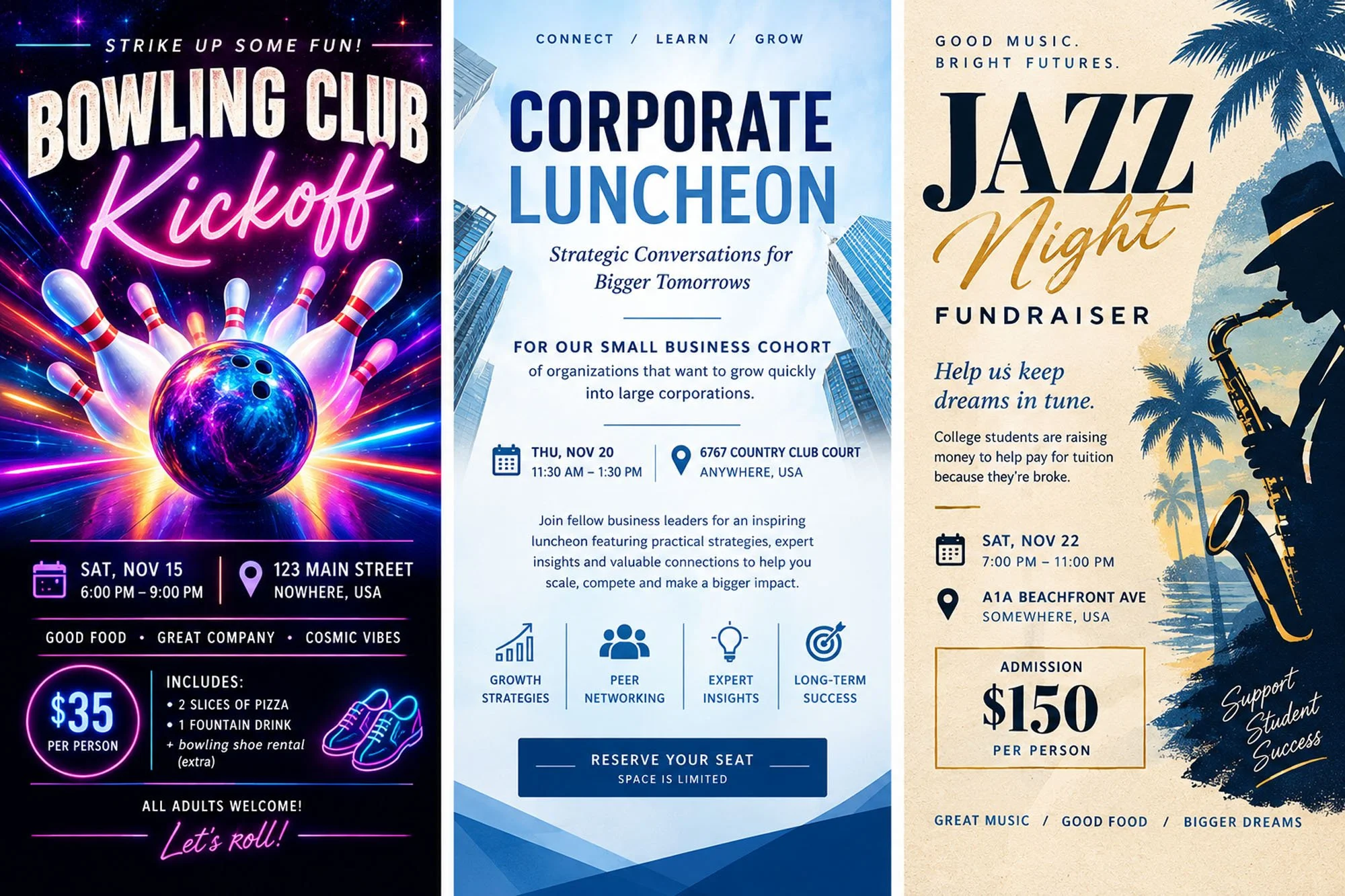
They’re all just so… cliche. And notice the bowling ball holes aren’t right, the calendar icon isn’t complete, the corporate icons are so generic and have been done over and over and over again, the alignment of the elements across the board are slightly off, and the messaging is just bad. I didn’t feed any messaging prompts, so this is what it came up with based on the event name.
Y’all. I’m seeing these everywhere now. School fundraisers. Church events. Nonprofit galas. The small business down the road announcing a sale. And over on LinkedIn, designers and marketers are arguing about it daily, with some calling AI design the end of the craft and others calling it the great equalizer. It’s rather exhausting.
So let’s have the honest conversation, sans shouting. Can AI do graphic design well enough to represent your business? Should you use it? And if you’ve already made one of these flyers, what does it say to the people you’re trying to reach?
AI Design & Its Role in Marketing
Can AI do graphic design?
Yes. AI can produce a finished-looking flyer, social graphic, or logo in seconds, and for some tasks that might be helpful. But…
I personally think this is the wrong question to ask.The better question is whether what it produces represents your business well, because marketing collateral isn’t just information. It’s a promise about who you are. If that feels kind of weighty, that’s a good thing. I meant it that way. 🙃
A tool is not a designer
In the spirit of transparency, I’ll be upfront. I use AI in my design work. I use it to remove backgrounds from photos, a tedious job I’m happy to hand off. Occasionally, I’ll have it generate a first pass at a document from a prompt. And every single time, I review what it made, and I almost always change it, because the first few versions are rarely right. The spacing is off, the hierarchy is muddy, or it simply doesn’t look like the brand it’s supposed to represent.
The distinction here is the human reviewing the output. AI as a tool in the hands of someone with a trained eye is one thing. AI as the designer, where whatever it spits out goes straight to the printer, is something else entirely. Even an office manager who is not a designer who reviews the AI output likely won’t understand the design flaws deeply enough to prompt it to a better result.
Think of it like a power drill. It makes building a bookshelf faster, but it doesn’t know where the shelves should go, how much weight they need to hold, or whether the finished piece belongs in your living room. And the person holding the drill needs to know how to use it so they get the job done properly and don’t injure themselves in the process. Somebody with the skill needed for the job still has to make these important decisions. When nobody fills that role, you get a hand with six fingers, or worse, a trip to the hospital.
The problem isn’t just the software. It’s skipping the judgment phase.
Can we all agree that our world in general could use a little better discernment? AI design is just one place where this is a serious need.
What your customers do when they notice
My designer-opinion aside, there is research to back me up.
Getty Images surveyed consumers about the imagery they want from brands, and people were more than twice as likely to prefer real images (38%) over AI-generated ones (15%) in marketing materials. Data from Klaviyo and Datalily found that only 7% of consumers say visible AI-generated marketing makes them trust a brand more, while 31% say it makes them trust the brand less. Those aren’t great odds for a flyer that’s supposed to get people in the door.
There’s also a peer-reviewed study from Washington State University where researchers surveyed more than 1,000 US adults and found that simply describing a product as using “artificial intelligence” lowered people’s willingness to buy it, because it lowered their emotional trust. To be fair, that study measured the word “AI” in product descriptions, not AI-made flyers, but it points to the same underlying truth: trust is emotional, and AI makes a lot of people uneasy right now.
Even the biggest brands aren’t immune. Coca-Cola’s AI-generated remakes of its classic “Holidays Are Coming” ads drew a wave of criticism in 2025, the second year in a row, with viewers calling them creepy and soulless. In fairness, research firm System1 found audiences were more forgiving privately than the comment sections suggested. Still, the conversation people had about Coca-Cola that season wasn’t about the soda, but about the choice.
"But can anyone even tell?"
Sometimes, no. In a 2026 study from Ipsos and Syracuse University’s Newhouse School, only 13% of viewers who watched an AI-made ad felt confident it was AI, and about the same share suspected AI in ads made entirely by humans. Polished AI work can slip right past people.
So my argument isn’t “you’ll get caught.” (Although, just recently, there was an uproar on Instagram about how social platforms are now labeling content as “made with AI”, even if only a portion of it was made using AI within a design tool. So people are noticing, and the fact that there was an uproar tells me something.)
Instead, my argument is this:
First, the hurried flyer shows its flaws. Extra fingers, misspelled headlines, faces that look a little too smooth, unusually sized and misaligned icons. When AI work looks low-quality or strange, people do judge the brand behind it. In DoubleVerify’s 2026 research across Europe, the Middle East and Africa, 42% of consumers said they’d feel negatively toward a brand whose AI-made ads looked uncanny or off.
Second, even when AI work is clean, it tends to look like everyone else’s. The same tools trained on the same images produce the same glossy families, the same soft-focus backgrounds, the same safe layouts. Your customers may not be able to name it, but they’ll feel that your flyer looks like the one from the business across town. And looking like everybody else has never once helped anybody get chosen.
Using AI to design your marketing materials will not make you distinctly different.You may not be able to own your design (aka copyright issues)
This may surprise you. In January 2025, the US Copyright Office concluded that images generated purely from a text prompt lack human authorship and aren’t eligible for copyright, and that picking your favorite from a handful of AI options doesn’t change that.
In other words, if your logo or signature event graphic came straight out of a prompt, you may not be able to stop someone else from using it. For a one-off yard sale sign, who cares. But for the logomark that is supposed to represent your business for the next ten years, you need to pause and consider this.
(I’m a marketer, not a lawyer. If you have a real question about your own logo, ask a lawyer.)
Additionally, an AI-generated design won’t allow you editing capabilities like an Adobe program would. If you need to make tweaks to a logomark, graphic, or icon down the road, you simple won’t be able to, unless you can get verrrrry clever with your prompting.
Will AI design get better? And can we recover from this?
This is my perspective, not a forecast backed by data, so take it as one marketer’s read.
I think the obvious tells will fade. In five years, the six-fingered human and the misspelled headline will probably be rare, because the tools improve quickly. So if your only objection to AI design is that it looks a little off, that objection has an expiration date, in my opinion.
What I don’t think will fade is the sameness, or the missing strategy behind the visual. AI can make a flyer, but it doesn’t know who you’re trying to reach, what they care about, or why they should choose you over the business down the street. That thinking has always been the real work of design. The software can get faster, but the thinking doesn’t get easier.
So can we recover from this flood of AI flyers? I believe we can in time, and I think the organizations that come out ahead will be the ones that treated their visual presence as stewardship of their reputation, not a box to check before Friday. The good news is, when everything else starts to look the same, the work that looks like you will get noticed more easily.
What to do instead
You don’t have to swear off AI. I certainly haven’t. You just have to decide where it belongs… as a tool in your tool belt.
AI is a fine helper for the behind-the-scenes jobs like removing a background, resizing a graphic for three different platforms, or giving you a rough first draft to react to. In every one of those cases, a person with a good eye still looks at the result and decides whether it’s ready.
Where a human designer should take over is with anything that carries your name into someone’s hands. Your logo, obviously. (I have strong opinions about this, but that’s a different conversation for a different day.) But also the pieces your customers see over and over: your event flyers, your social templates, your sales sheet, the banner at your booth. Those are what people remember you by, and they deserve a considered decision behind every choice.
If you’re a small team or a volunteer-run organization (and so many of the schools and churches I love are), here’s the middle ground I’d recommend. Invest once in a small set of professionally designed templates built on your brand (your colors, fonts, photography style, etc.). Then your staff or volunteers can drop in this month’s date and details without starting from a blank prompt. You get consistency without needing a designer for every bake sale, and nobody ends up with a junk flyer that blends in with everything else in their purview.
Here’s The Point
Can AI do graphic design well enough to represent your business? It can make something that looks finished, but whether it represents you well depends on whether a person with judgment stands between the prompt and the printer.
If you’ve been making AI flyers because you’re stretched thin, I get it. You were busy, not careless, and this is completely overcomeable. Keep AI for the tedious stuff, put real design thought into the pieces your people see most, and give your volunteers or staff templates that make doing it right the easy option.
Your customers, donors, and neighbors are deciding whether to trust you before they ever read a word. Give them something that looks like you, made with care. Do not become complacent!
Commons Questions About AI Graphic Design
-
Yes, AI can generate flyers, social graphics and logos quickly. What it can’t do is understand your audience, your goals, or your brand teh way a person can, so its output works best as a starting point someone reviews and refines.
-
I don’t think so. It’s changing how designers work, taking over tedious tasks like background removal and resizing, but strategy, judgment, and taste still require a human.
-
It’s helpful for drafts and production tasks. For customer-facing pieces, consumer research suggests visible AI imagery can lower trust, so have a trained eye review and refine anything that represents your brand.
-
According to the US Copyright Office’s 2025 report, images generated purely from prompts aren’t copyrightable, though work with meaningful human authorship can be. Ask an attorney about your specific situation.
-
Common signs include distorted hands, garbled or misspelled text, overly smooth faces and objects that don’t make physical sense. As tools improve, these tells are becoming harder to spot.
-
It carries real risks: you may not be able to protect it legally or edit it well, and it may look like other AI-made logos. For a mark you’ll use for years to build trust with your customers, it’s worth investing in original design.
-
They do different jobs. AI is a fast tool; a designer brings strategy and judgment. The strongest results usually come from a designer who uses AI where it helps.

Ready for marketing that looks like you?
The Project Sprint is a focused design project scoped to one deliverable (like a set of brand templates your team can reuse or the sales sheet you hand out every week).
You get thoughtful design built on your brand, and you walk away with something you’re proud to put in people’s hands.
Next Up in the Field Guide Series:
When to start planning next year’s marketing.